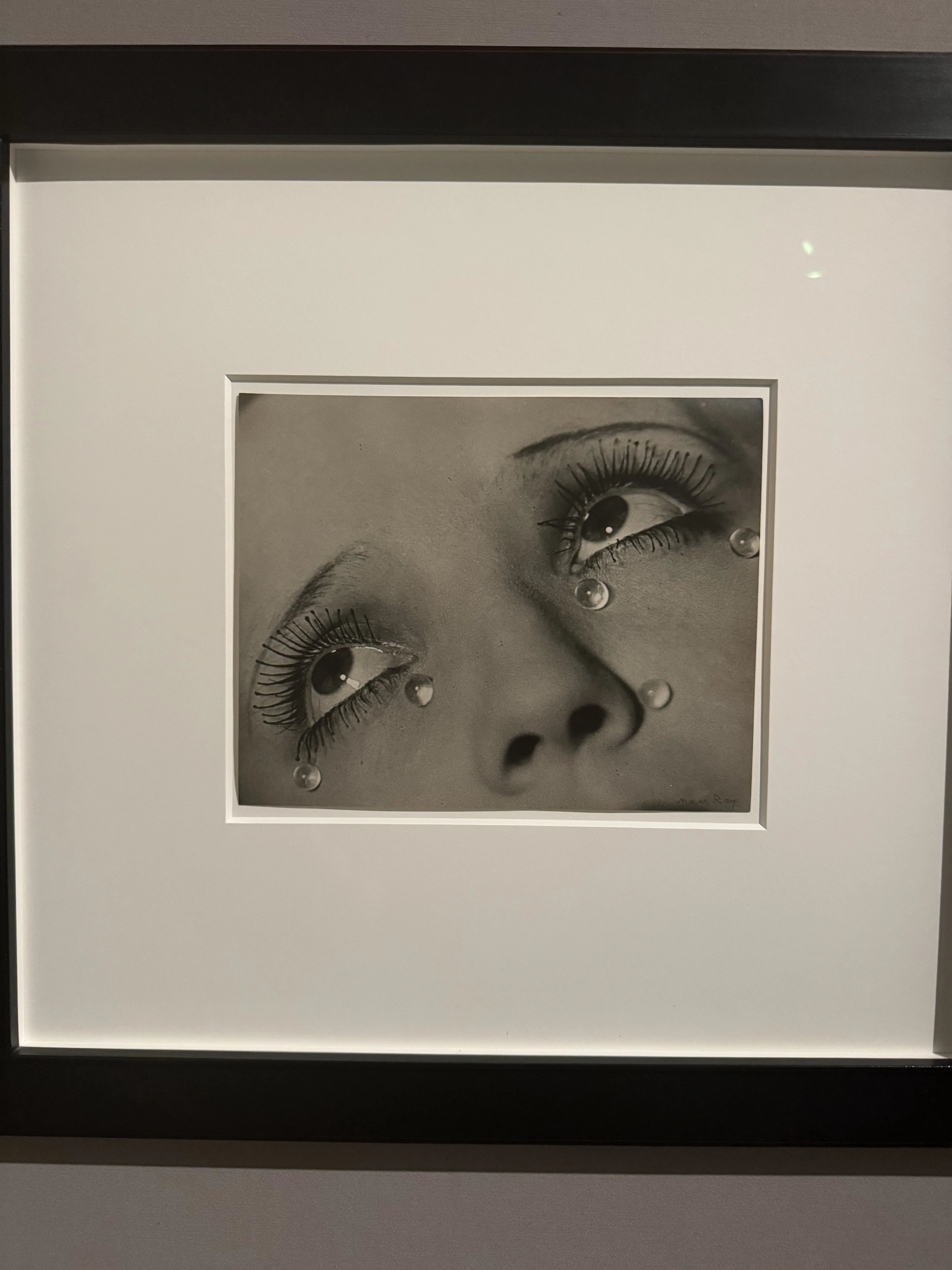
This is not a photograph to be evaluated — it is Man Ray's 'Glass Tears,' 1932, one of the fifty most important photographs in the Western canon. The score and tier apply to the original work, not to the iPhone document of it. As a document, this image is a study at best; as the object being documented, it is irreducibly exhibition-grade. The glass beads remain among the most precise deployments of artificial punctum in photographic history.
- Formal
- The photograph within the frame is a tight close-up of a face cropped to eyes and nose bridge, filling the picture plane with radical intimacy. The outer photograph — a museum visitor's record shot — creates a frame-within-frame that contextualizes the original as artifact. The inner image uses diagonal tension between the two eyes positioned at upper-right and lower-left, stabilized by the nose anchoring the lower center. [object Object]
- Technical
- The inner original print appears critically sharp on the lashes and glass beads. The iPhone capture introduces moderate softness and reflection glare (upper right of mat) that compromises the document but does not obscure reading of the work. The iPhone exposure is slightly hot on the white mat, compressing highlight detail there; the inner image is readable but not optimally rendered. The original print's exposure, as visible, appears precise — the glass beads hold specular highlights without blowing. The original image uses a narrow tonal range deliberately — this is not a full-range photograph but a controlled, nearly graphic compression. The iPhone's capture flattens this further and introduces reflective hotspot on the glazing.
- Semantic
- This is Man Ray's 'Glass Tears' (Larmes), 1932 — one of the defining objects of Surrealist photography. The tears are glass beads, the emotion is simulated, the eyelashes are almost certainly false. The image is an interrogation of feminine grief as spectacle, a construction of sorrow rather than its documentation.
- Historical
- European Surrealism; Modernist close-up portraiture; Fashion and advertising photography of the interwar period; The photograph as conceptual object; [object Object]; [object Object]; [object Object]
- Curatorial
- The artificial teardrops function simultaneously as formal elements (spheres against flat tone) and conceptual argument (grief as theater) The compression of tonal range transforms skin into an abstract surface, making the face a ground for objects rather than an expressive subject The radical crop denies individuality and forces the face into archetype — this is not a woman crying, it is crying as image, grief as production