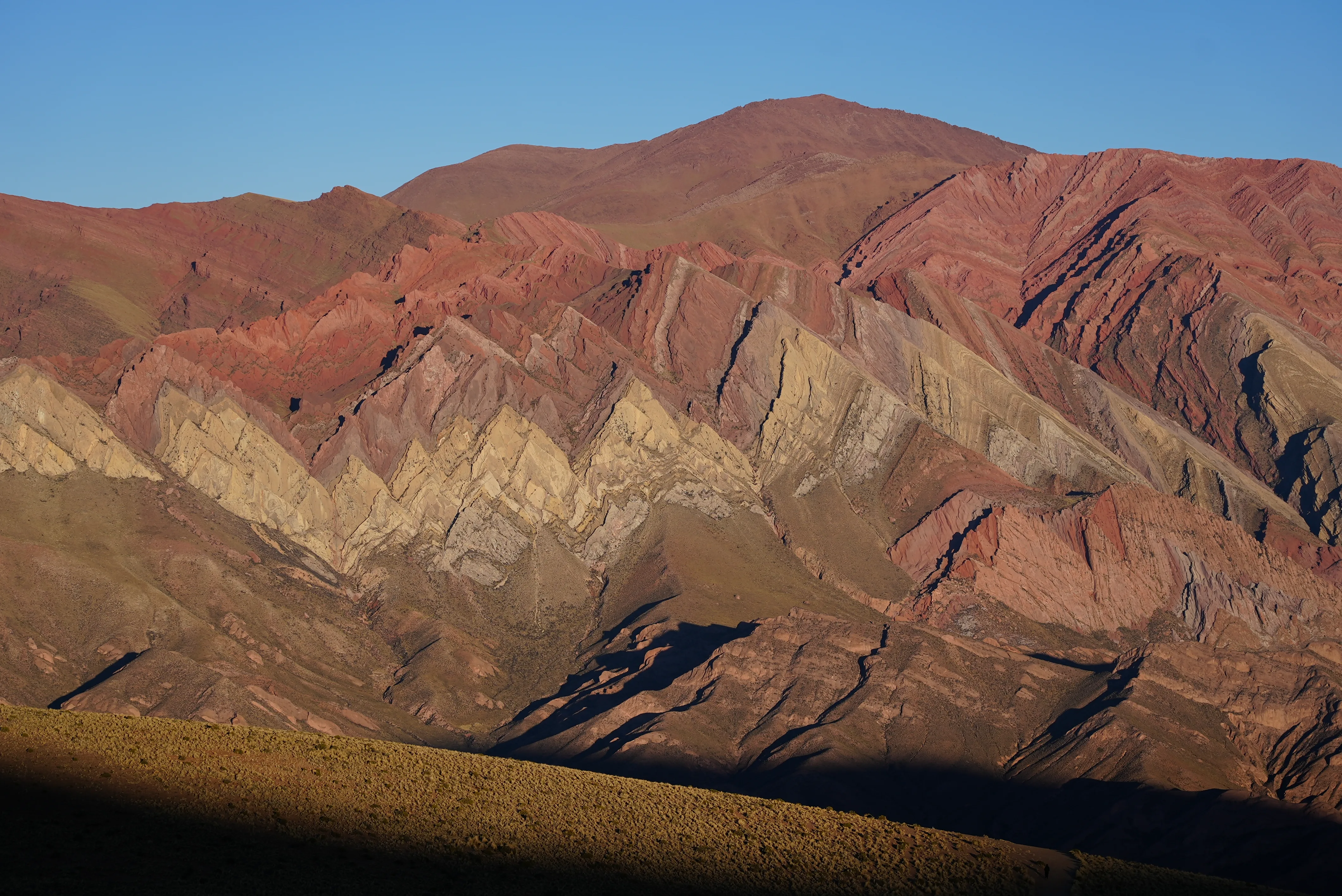
The image succeeds because the photographer understood that raking light and telephoto compression would transform a landscape into a formal diagram of geological time. The color relationships — the warm reds against the pale central stratum against the cool sky — are structurally sound, not accidental. What prevents exhibition tier is a residual passivity: the composition is well-observed but not fully invented. The horizontal banding strategy, while effective, is the expected solution for this subject. A more demanding framing decision — tighter on the serration, or a perspective that disrupts the sediment-layer logic — would have pushed this further.
- Formal
- Horizontal banding strategy that stacks geological layers as distinct visual registers. A dark foreground strip anchors the base, followed by a lit scrubland transitional zone, then the corrugated mid-range ridge, and finally the broad dominant peak against a flat sky. The composition reads as a series of receding planes rather than a single panoramic sweep. [object Object]
- Technical
- Critical sharpness falls across the mid-range ridgeline. The foreground scrub is slightly soft due to depth-of-field fall-off under telephoto compression, which is appropriate — it keeps visual hierarchy clean. The peak transitions into slightly less defined tonality, consistent with atmospheric haze at distance. Well-judged for the warm-lit rock faces. Shadow areas are allowed to go dense without blocking completely, preserving some texture in the ravines. The blue sky holds detail without being blown. No significant clipping apparent in either extreme. The sensor handles the scene's considerable contrast range competently. The brightest pale stratum and the deepest shadow gullies coexist without catastrophic clipping in either direction. Some shadow compression is visible but reads as intentional.
- Semantic
- This is geology as time made visible. The colored strata — iron-rich reds, oxidized ochres, pale limestone or sandstone bands — are epochs of sediment compression and tectonic folding exposed to the surface. The raking light is doing the interpretive work, turning each fold into a shadow event.
- Historical
- New Topographics — landscape as document, without sentimentality; Color field landscape photography using geological color as structural element; South American landscape tradition engaged with Andean geological monumentality; [object Object]; [object Object]; [object Object]
- Curatorial
- Raking light exploited at maximum effectiveness — shadow and highlight define the geological folds with architectural precision Telephoto compression transforms depth into pattern, turning the layered ridges into a relief-map that reads as both document and abstraction Color relationships between iron-red strata, pale sandstone band, and cool sky are structurally rigorous without obvious manipulation