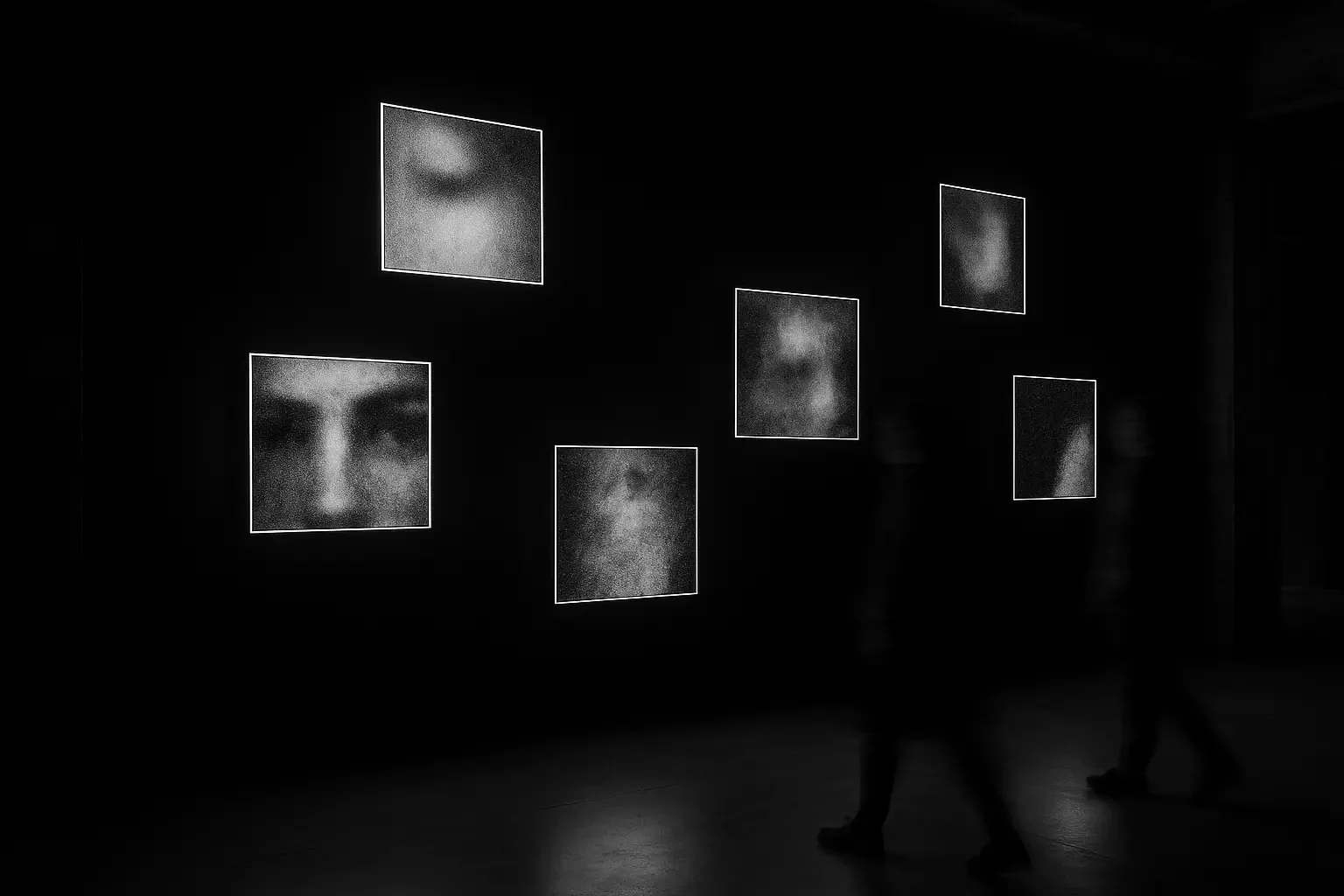
This is a photograph that understands what it is looking at and builds a formal argument around it. The tonal discipline is exceptional — the void is not empty, it is structured. The silhouette as counterpoint to the luminous faces is the decisive formal choice, and it works: the living body reduced to shadow while fragmented, grainy faces carry the light. What keeps this from exhibition tier is its dependency on the installation as subject — the photograph's power is substantially borrowed from the artwork it documents, and the formal invention at the level of the camera itself, rather than the arrangement of the installed work, does not fully transcend that dependency.
- Formal
- A dark gallery space with six illuminated square frames arranged in a loosely diagonal scatter across two converging walls, with a silhouetted figure entering from the right edge. The frames create a constellation of light sources against near-total darkness. [object Object]
- Technical
- The frames on the primary wall are critically sharp at their edges. The silhouette is intentionally rendered as a near-featureless shadow. The faces within the frames carry their own blur as a function of the artwork being photographed. The exposure is precise for this extreme contrast scenario. The brightest areas within the frames retain detail without blowing. The black space holds texture in the floor's reflective surface. A technically demanding balance, well-executed. The dynamic range is compressed by intent — this is a photograph of darkness punctuated by light, not an attempt to render a full tonal scale. The floor's faint reflection is the only shadow detail outside the frames.
- Semantic
- The viewer passes through — or past — a constellation of disintegrating faces. The faces do not cohere into a single identity; they fragment across scale and position. The viewer's presence is reduced to shadow while the faces, blurred and grainy, insist on a ghostly specificity. Seeing and being seen are inverted.
- Historical
- Photography of photography — the meta-documentary tradition of photographing installations and exhibitions; New Objectivity's interest in surfaces and structure; The phenomenological documentation of space as experienced rather than described; [object Object]; [object Object]; [object Object]
- Curatorial
- Tonal control in extreme low-key conditions is technically precise — highlight retention within the frames while maintaining floor reflectivity is a difficult exposure balance achieved cleanly The silhouette placement at the frame's right edge functions as both spatial anchor and conceptual argument — the human body made less present than its fragmented representations The corner geometry creates genuine spatial depth, preventing what could be a flat arrangement of light sources from becoming a two-dimensional pattern