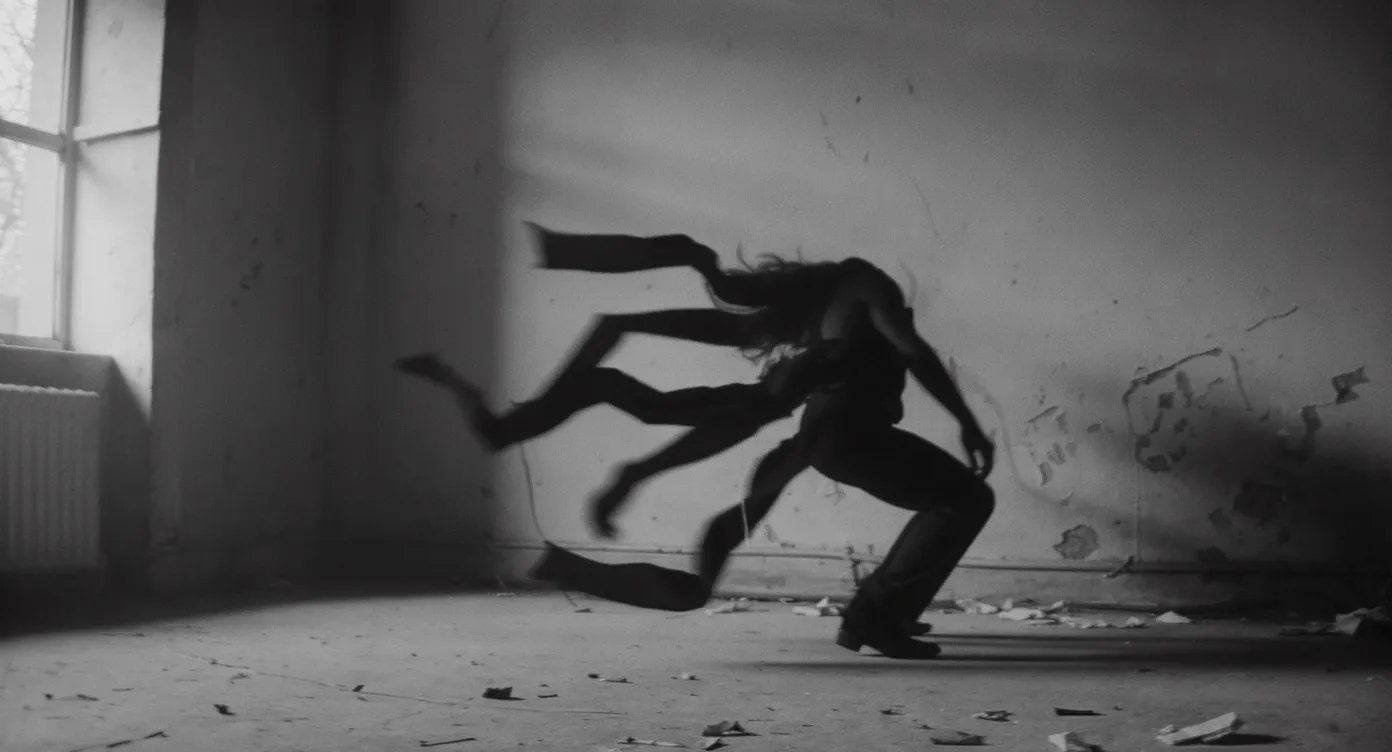
The image succeeds because its formal strategy and semantic content are unified — the disintegration of the body through motion blur is not a technical accident but the subject itself. The choice to let the figure become monstrous through duration, set against a space of architectural decay, produces genuine conceptual coherence. It is held from exhibition tier by a slight compositional imbalance — the floor debris at lower right feels unresolved rather than purposeful, and the window's blown highlight, while controlled, introduces a competing brightness anchor that slightly weakens the figure's tonal dominance.
- Formal
- The figure is placed slightly left of center, creating diagonal tension that pulls the eye toward the corner junction of two walls. The weight of the frame is asymmetric — the bright window anchors the upper left while the peeling wall texture anchors the lower right, bracketing the figure between two forms of decay. [object Object]
- Technical
- Intentional motion blur dominates — critical sharpness is sacrificed entirely in service of conveying kinetic violence. The torso core may retain fractional sharpness but the limbs are fully motion-smeared. This is a deliberate exposure or movement choice, not camera failure. Slightly underexposed on the figure to push it toward full silhouette. The window is blown but this is controlled — the overexposure functions as a light source anchor. Shadow retention in the room walls is sufficient to preserve architectural texture. Compressed intentionally. The photographer has sacrificed the full tonal range in favor of a narrower, darker palette that concentrates meaning in the dark figure against a gray rather than bright ground.
- Semantic
- A body in extreme movement — limbs flung in multiple directions simultaneously — occupies an abandoned room. The motion blur multiplies the figure into something closer to creature than human, suggesting possession, rupture, or ecstatic dissolution. The peeling walls and scattered debris on the floor participate in the image's central metaphor: disintegration as presence.
- Historical
- Black and white experimental dance photography; Post-war European existentialist image-making; Butoh documentation photography; Abandoned space as studio — the ruin aesthetic; [object Object]; [object Object]; [object Object]
- Curatorial
- Motion blur deployed as ontological statement, not technical shortcut — the multiplication of limbs transforms the human into something mythological Tonal compression and deliberate underexposure create a unified dark palette that gives the image psychological weight rather than documentary legibility The architectural environment is actively chosen and functions symbolically — decay rhymes with dissolution rather than serving as mere backdrop